

When you receive a tax assessment from KRA, it’s not business as usual. Whether you are a business owner or an individual taxpayer, you know very well that such an assessment means two things: you might lose your money to KRA or get dragged through time-consuming correspondence trying to iron things out with the tax authority.
You might be tempted to panic-call your accountant and start planning how you’re going to settle the tax assessment. Or maybe you want to argue with them to see where things went wrong. The truth of the matter is, no taxpayer is ever prepared for their first unsatisfactory tax assessment. That’s why we prepared this guide. In this guide, we show you how to file a tax objection in Kenya. You’ll learn what counts as valid grounds for objection, what the timeline looks like in practice, and what has changed under KRA’s tighter verification process in 2026.
Taxpayers who require professional assistance can use our Tax Objection Preparation & Filing Services in Kenya for assessment review, preparation of grounds of objection, supporting-document organization and iTax filing.
First Things First: The 30 Day Rule is Absolute
In our many years of tax practice, we’ve seen desperate taxpayers watch as a tax objection opportunity passes them by just because they missed the 30-day rule. For KRA, this timeline is an absolute; not objecting to their tax decision within this time frame is a through pass for them to enforce the assessment. You don’t want that. You deserve a fighting chance, especially when you know very well there are solid grounds for objecting.
Section 51 of the Tax Procedures Act 2015 gives you up to 30 days from the date you’re notified of a tax decision to lodge a Notice of Objection. KRA notifies you via email, iTax, or a physical letter. Be vigilant. Regularly check your emails, iTax portal, and physical mailbox to ensure you’re on track with any communications from KRA. Once you receive an assessment, note the date of service and count forward 30 days. Mark it on your calendar and set a reminder.
Understanding the deadline is only one part of the objection procedure. Taxpayers should also understand the broader tax objection process in Kenya, including how an objection is reviewed, how supporting documents are considered and how KRA reaches an Objection Decision.
Know the Valid Grounds for Objection
Not every tax assessment meets the criteria for objection, and you don’t want to waste time only for KRA to dismiss your objection for vague grounds. You must have valid grounds for objection before lodging a Notice of Objection. These include:
- Wrong Tax Rates Were Applied: KRA applied incorrect tax rates, resulting in incorrect figures and miscalculations.
- Legal Errors: KRA applied or misinterpreted provisions of the Income Tax Act, Value Added Tax Act, Excise Duty Tax, etc.
- Wrong Tax Head: KRA has assessed tax under the wrong tax category.
- Factual Errors: KRA has used disallowed business expenses, failed to account for exempt income, or used incorrect figures.
- Misinterpretation of Documents: KRA read and misinterpreted your documents, leading to disagreements over tax expectations.
- Procedural Issues: The assessment was based on incomplete information, or the KRA didn’t follow the required statutory procedure before issuing the tax assessment.
Once you’ve established that valid grounds for objection exist, it’s time to lodge a Notice of Objection. Some disputed tax assessments arise from findings made during a KRA audit. Where the objection relates to audit findings, professional KRA Tax Audit Services in Kenya can help taxpayers review KRA’s findings, reconcile the underlying records and identify issues that may form valid grounds of objection.
Pay Undisputed Tax
Section 51 of the Tax Procedures Act states that for a tax objection to be valid, the taxpayer must first pay the undisputed tax amount in full. Failure to do so will see your objection rejected for violating procedural requirements. Paying the undisputed tax adds credibility to your case and has some perks. These include:
- Once you pay the undisputed tax, KRA suspends the collection of the disputed tax until an Objection Decision is issued.
- KRA can’t freeze your bank account or issue agency notices to recover the disputed amount while the objection is being reviewed.
How to File a Tax Objection in Kenya: Step-by-Step Guide
Before filing an objection, consider obtaining a professional review through our KRA tax assessment services in Kenya to identify calculation errors, unsupported assumptions and the documents required to support your position. Here is the step-by-step guide on how to file a tax objection in Kenya:
Step #1: Gather Supporting Documents
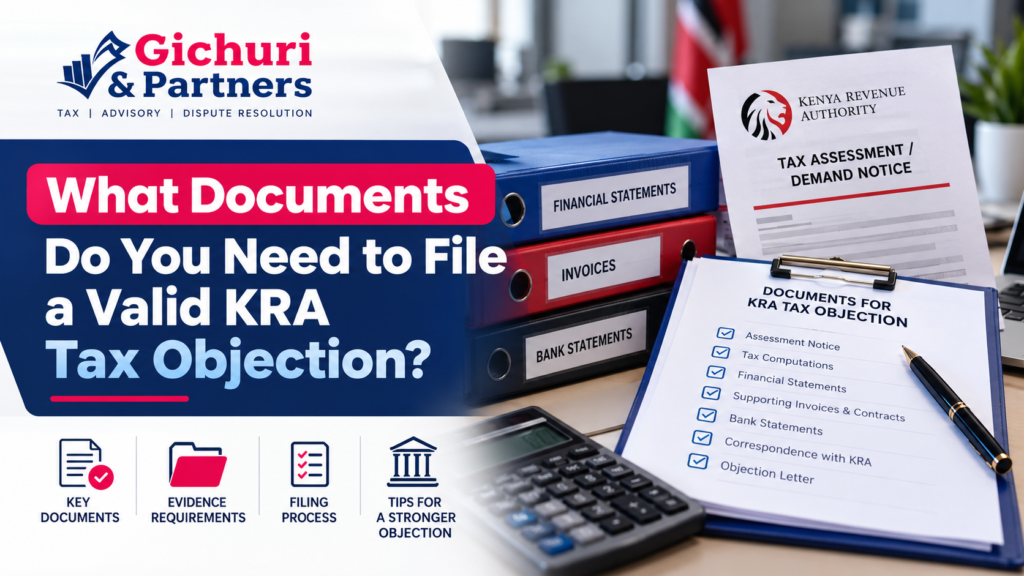
The burden of proof always lies with the taxpayer. Therefore, you must have the necessary documents to support your claims and arguments. These include invoices, original tax returns, filing and acknowledgment receipts, bank statements, and any prior correspondence with KRA.
For complex or high-value assessments, professional KRA Tax Dispute Resolution Services in Kenya can help taxpayers review the disputed issues, reconcile supporting records and develop an evidence-based strategy for challenging KRA’s position.
Note: 2026 KRA Reality Check: KRA now cross-verifies tax objections against eTIMS records, bank records, and prior filings before a human KRA official reviews your case. If a disputed invoice doesn’t match what’s in eTIMS, it gets flagged automatically. It doesn’t matter how well you’ve argued in your objection letter. Reconcile your eTIMS records before filing an objection.
Step #2: Write the Objection Letter (Notice of Objection)
What makes a good objection letter? Three things:
- Clearly state your grounds for objection.
- Explain your grounds with evidence.
- Request a specific outcome (Prayer).
See our objection letter sample for reference. Otherwise, below is a good structure for a winning objection letter:
- Reference the Tax Decision: Include the date, decision number, and tax type.
- State Your Grounds: State your grounds in numbered, plain, and factual language. Show no emotion or generalized complaints.
- Explain Each Ground: Expound each ground separately using dates, figures, and references. For instance, In January 2025, I filed a VAT return for the December-January tax period showing an Output VAT of Ksh: 1,000,000. KRA’s assessment of 30th May 2025 increased this to Ksh. 1,750,000 without specifying which transactions were adjusted.
- State Your Prayer/Relief Sought: What are you asking for? State your specific outcome. This can be a full reversal, partial adjustment, or reassessment.
- Attach Your Supporting Documents: Remember to reference them by number in the letter.
Step #3: File the Notice of Objection via iTax
KRA no longer accepts physical letters or emails. You need to lodge your tax objection via iTax. Here are the steps to file a Notice of Objection on iTax:
- Log in to your KRA iTax portal.
- Navigate to Disputes.
- Select File Objection.
- Select the Tax Type.
- State your reasons.
- Upload supporting documents.
- Submit your objection and get an Acknowledgement Receipt.
You’ve successfully filed your tax objection, but the process does not end there. Once a valid objection has been lodged, it proceeds for review through the Independent Review of Objections (IRO), where the taxpayer’s grounds of objection, supporting documentation and the disputed tax position are considered before an Objection Decision is made.
What Happens After Filing a KRA Tax Objection?
After a valid KRA tax objection is lodged, the objection proceeds for review through the Independent Review of Objections (IRO). During the review, the taxpayer may be required to provide additional information, clarification or supporting documents relating to the disputed tax decision.
Therefore, as you wait, note the dates and mark your calendar. However, don’t just wait and assume KRA will update the system automatically. Do the following as you wait:
- Look out for possible requests for clarification or additional documents. When they do, respond immediately. Delays can work against you here.
- Visit KRA offices near you to formally let them know that the 60-day window has expired.
- You can also write to the Commissioner of Domestic Taxes.
- Request a formal written confirmation that your tax objection has been allowed.
The Objection Decision
An Objection Decision is the formal verdict from the KRA following your application to object to a tax assessment/decision. It simply details whether the Commissioner has accepted or rejected the issues you raised in the objection. It can:
- Allow the objection
- Disallow the objection
- Allow the objection in part
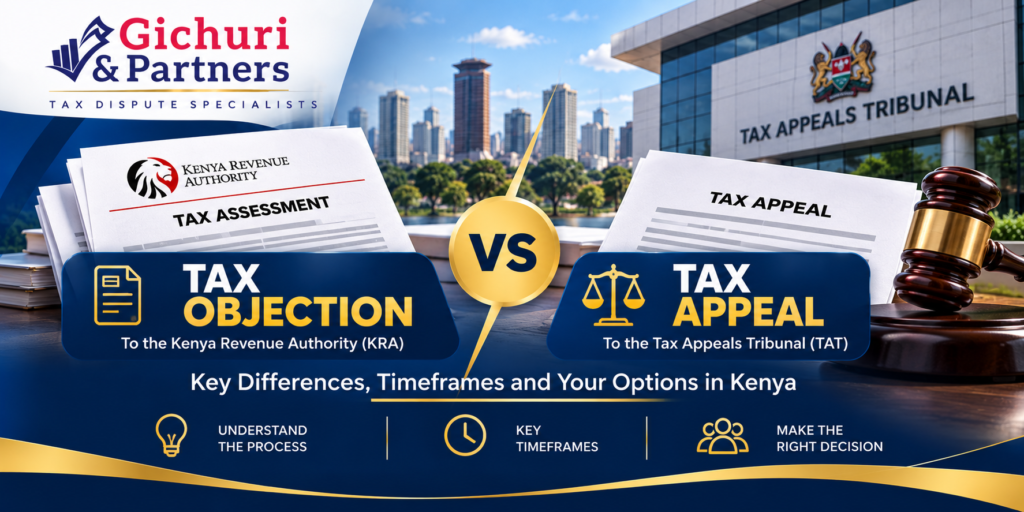
In the case where the objection was disallowed or allowed in part, you have a 30-day window to escalate the case. There are two ways to escalate an unsatisfactory objection decision:
- Negotiation with KRA under the Alternative Dispute Resolution (ADR) pathway.
- Litigation by filing an appeal at the Tax Appeals Tribunal (TAT).
Then there is the good part- if KRA allows your tax objection, you still have something to do to finalize the process. Log in to your iTax portal and ensure KRA has updated your profile. Confirm the following:
- The disputed tax, penalties, and interest have been completely amended or vacated (your figures should read zero).
- Download and print the decision and store it with your business or personal records.
Common Mistakes to Avoid When Filing Tax Objections in Kenya
Do you want your tax objection to have a favorable outcome? Avoid the following mistakes:
- Late Filing: You must take the 30-day deadline seriously or have a really good cause to request an extension from KRA.
- Vague Grounds: This is honestly one of the weaknesses that makes KRA disallow tax objections. Avoid emotional arguments like “this isn’t fair”. Instead, state factual and legal grounds why you think the tax decision is wrong.
- No Supporting Documents: Word of mouth is invalid when it comes to legal tax matters. Make sure you have adequate supporting documents for your assertions. Additionally, ensure your documents reconcile with eTIMS records.
- Failure to Pay the Undisputed Tax: By law, a tax objection is only valid if the taxpayer has paid the undisputed tax in full.
- Going silent when KRA requests clarification or additional documents.
- Treating a Tax Objection Emotionally: There is no place for emotions in KRA tax disputes. Table your evidence and convince the Commissioner that, indeed, KRA is wrong.
Taxpayers dealing with complex assessments can seek professional KRA Tax Objection Services in Kenya to review the disputed tax decision, identify valid grounds of objection, prepare supporting documentation and manage the objection process within the required timelines.
Final Thoughts
The success of a tax objection depends on meeting statutory timelines, establishing valid grounds and presenting strong supporting evidence. If you are facing a disputed KRA assessment, our KRA Tax Objection Services in Kenya can help you review the tax decision, prepare the grounds of objection, organize supporting documentation and manage the objection process through IRO.