
Have you found yourself in a tax dispute with the Kenya Revenue Authority (KRA)? Maybe you received a tax assessment that you disagree with, or maybe KRA is demanding payment of an unpaid tax debt you want to challenge? If you’re already weighing your options, you’ll likely come across the words tax objection and tax appeal. Like many taxpayers facing their first dispute with KRA, you might wonder: What is the difference between a tax objection and a tax appeal in Kenya?
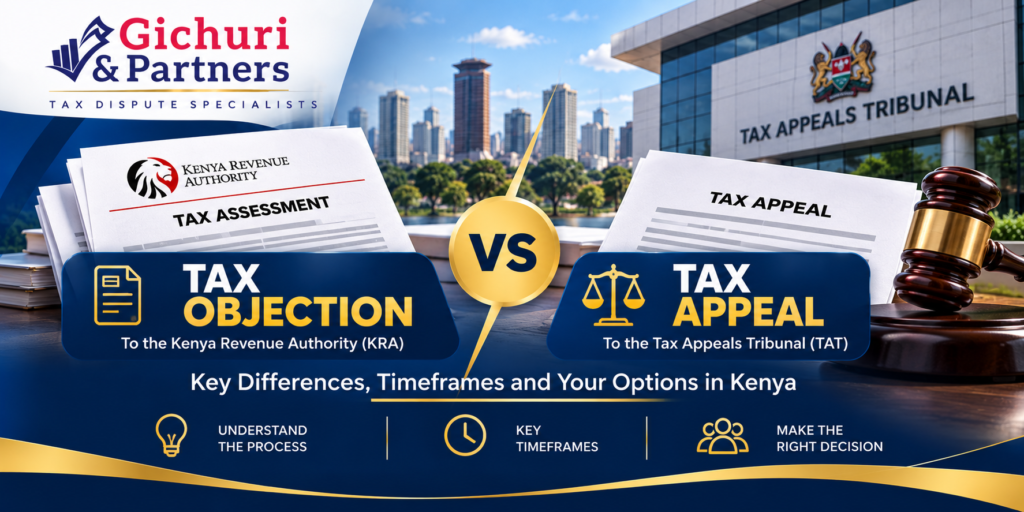
If that’s you, we made this explainer for you. A tax objection basically challenges a tax decision/assessment by KRA, while a tax appeal contests an appealable tax objection decision (simply called an objection decision) before an independent tribunal.
These two processes are interconnected, but they are also individual procedures with significant differences. In this tax objection vs. tax appeal in Kenya showdown, we compare the two processes. We will also highlight what makes a decision appealable, when it’s appropriate to appeal a tax objection, and when it’s not.
Tax Objection Vs. Tax Appeal: What is the Difference in Kenya?
A tax objection and a tax appeal are two distinct stages of challenging a tax decision by KRA.
The main differences are who reviews your case, the procedures involved, what you need to establish for a favorable outcome, and when you can challenge a decision. Below is a comparison table showing how the two processes compare:
Comparison Aspect |
Tax Objection |
Tax Appeal |
| Definition/Meaning | A formal challenge asking KRA to review and reconsider a tax decision. | A formal challenge asking an independent tribunal [Tax Appeals Tribunal (TAT)] to review and determine an objection decision. |
| Who handles it? | KRA’s Independent Review of Objections (IRO) and the KRA Commissioner | The Tax Appeals Tribunal |
| When does it apply? | When you first dispute a tax decision (tax assessment/ audit report, etc) | After receiving an unfavorable objection decision that is legally appealable. |
| Main purpose | To persuade KRA to correct, reduce, or withdraw a tax assessment. | To obtain a legally binding determination or solution to a tax dispute with KRA |
| Is the process independent? | No. This is a KRA-affiliated dispute resolution process, although the IRO is an independent department within the agency | Yes. The TAT is an independent quasi-judicial body separate from KRA |
| Timeline | Within 30 days of being notified of a tax assessment/decision | Within 30 days of receiving an objection decision. An extension is available depending on the nature of your case and applicable laws. |
| Validity requirements | A valid tax objection must establish the grounds of objection, the relief/corrections being sought, and supporting documentation | A valid tax appeal must establish why the tax division should be overturned or varied and be supported by relevant facts, arguments, and evidence |
| Supporting Evidence Required | Tax returns, invoices, contracts, sales receipts, and reconciliations | The dispute, legal arguments, financial statements, contracts, service agreements, copies of original eTIMS-compliant tax invoices, proof of payment, KRA iTax status printouts, etc |
| Potential Outcomes | KRA may allow the objection fully, partially, or disallow it. | The TAT may dismiss the appeal or provide appropriate relief subject to applicable laws and your particular case. |
| Costs | Professional fees if you hire a tax expert to prepare an objection and handle correspondence with KRA | Tribunal fees (KES 20,000), professional, and litigation fees |
| Escalation | If you lose, you can escalate the matter to the TAT | If you lose, you can escalate the matter to the High Court |
Is Every Unfavourable Tax Objection Decision Appealable?
No. Not every objection decision that you disagree with is appealable. The following factors determine whether an objection decision is appealable or not:
- Jurisdictional factors: Was the tax objection valid in the first place? You must have filed the tax objection within statutory timelines, provided solid grounds of objection, and paid the undisputed tax.
- Substantive factors: The decision must carry an immediate and adverse legal, proprietary, or financial impact. Is there any liability, penalty, or restriction that the Tribunal can intervene in? If there is none, then it’s not appealable.
- Procedural factors: You must file a Notice of Appeal within 30 days from the day you were notified of the objection decision.
If you want your tax dispute to be appealable, you must strictly follow procedural requirements that make an objection valid from the outset. If KRA disallows your objection for being invalid, that could be the end of the road for you if your next step was litigation.
However, you can still explore other options like the Alternative Dispute Resolution (ADR) process. Before appealing a tax decision, you need to establish whether the decision is legally appealable so that you don’t waste your time and money. Remember, there is a KES 20,000 filing fee and a backlog of appeal cases at the TAT. You better make sure a tax decision is appealable and worth your effort before proceeding.
When is Appealing a KRA Objection Decision a Good Idea?
Most taxpayers think of tax appeals as the next reflex reaction to losing a tax objection. This is unwise from a legal and financial standpoint. That’s why it’s important to engage a tax dispute specialist or a tax attorney before moving forward with an appeal.
For starters, you should only move forward with an appeal when you have irrefutable documentary evidence that KRA has committed a clear procedural or legal error. Another significant factor is the cost. Does the disputed tax amount outweigh the legal costs and potential penalties? Below are situations when appealing a KRA objection decision makes sense:
- You have the required paperwork like ETR receipts, valid customs documents, and other solid legal proof to proceed.
- KRA is trying to enforce a tax debt in which they missed the provided statutory timelines. For instance, if KRA doesn’t provide an objection decision within 60 days after filing your objection, it’s deemed allowed. If they try to enforce the tax assessment despite this, you have a real fighting chance.
- The tax dispute is a question of the law, or its interpretation.
- Your initial tax objection was legally thorough, and you raised sound grounds for objection.
- The cost of litigation is significantly lower than the tax liability you’re facing.
- You can manage to pay the undisputed tax amount comfortably.
- You want to buy time for ADR. When you have a robust case, appealing stops KRA from enforcement.
When is it a Bad Idea to Appeal a KRA Objection Decision?
Not every unfavourable objection decision should move forward to the Tax Appeals Tribunal. Here are situations when it is a bad idea to appeal an objection decision from KRA:
- When you have missing, unreliable, and irrelevant records.
- The litigation, professional representation, and overall costs of the appeal outweigh the tax saved.
- The statutory timelines aren’t on your side. An appeal is only valid when filed within 30 days after being notified of the objection decision.
- There is no legal gray area or misinterpretation of tax laws. The TAT doesn’t rewrite tax laws; it uses existing laws to determine your case.
- There is a tax risk of triggering more scrutiny from KRA. This is called tax exposure.
If it doesn’t make sense to appeal a KRA objection decision but you’re still unsatisfied with the outcome, you could explore the following options:
- Alternative Dispute Resolution (ADR)- You can negotiate with KRA in this non-adversarial process facilitated by an independent mediator.
- Accept the tax liability and request a voluntary waiver/tax amnesty instead.
- Negotiate a manageable payment plan that doesn’t strain your cash flow.
Alternative Dispute Resolution (ADR) – A Real Choice For Resolving KRA Tax Disputes
In recent years, KRA has resolved hundreds of tax disputes with taxpayers through ADR, saving both parties millions of shillings. ADR’s success has demonstrated that it’s a real choice for taxpayers still unsatisfied with how KRA handled their tax objection. The choice is no longer between appealing the case to the TAT and accepting KRA’s decision. There is another route, offering a real chance and real benefits. Here is why you should consider ADR:
- It is a voluntary process facilitated by an independent mediator that seeks to help you and KRA reach a mutual agreement.
- It comes in handy when the tax dispute can be resolved through clarification of transactions or settlement discussions.
- It is relatively cheaper and less time-consuming compared to litigation.
However, ADR should not automatically replace the TAT appeal. If you still want a chance to have a shot with the TAT in case ADR fails, confirm the applicable procedural requirements and timelines. See our detailed ADR guide to learn more about this alternative route for tax dispute resolution.
Final Thoughts
The main difference between a tax objection and a tax appeal in Kenya is who reviews your case. In the former, KRA’s Independent Review of Objections (IRO) does the job and makes recommendations to the Commissioner, who issues an objection decision. In the latter, the Tax Appeals Tribunal (TAT) hears and determines your case. Not every unfavorable objection decision warrants an appeal. Before you escalate the tax dispute, assess why KRA rejected it, the reasons, available evidence, costs, and potential outcome. A tax dispute specialist becomes an important partner at this stage.