
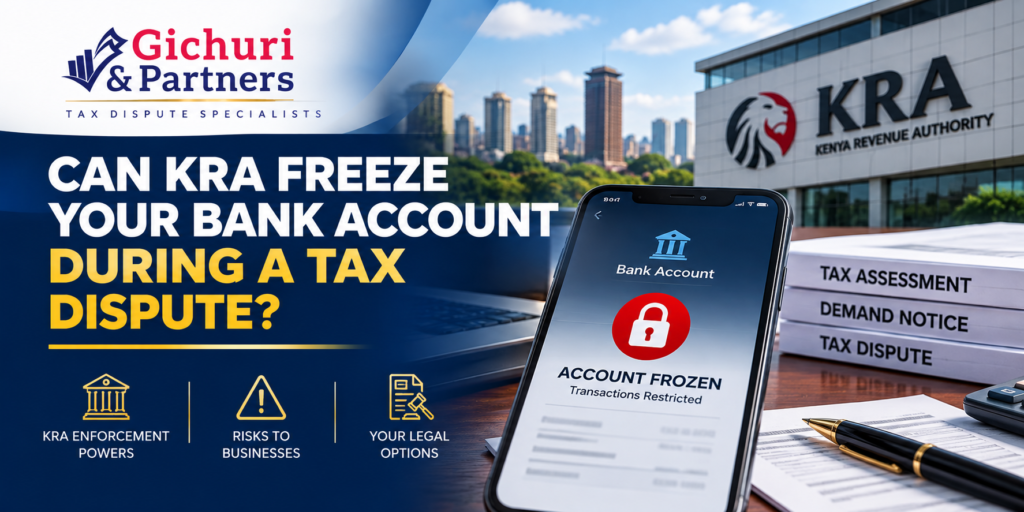
If you have an ongoing tax dispute with the Kenya Revenue Authority (KRA), you might be anxious about your assets and how the law protects them. Can KRA freeze your bank account or issue an agency notice to your bank while a tax dispute is ongoing? Does filing a tax objection or a tax appeal offer protection against KRA’s enforcement tactics? If KRA is already on your neck, what are your options? Can the Tax Appeals Tribunal (TAT) intervene to protect your money?
A proposal in the Finance Bill 2026 tried to give KRA unlimited powers to enforce debt recovery despite the status of the tax dispute. If this bill had passed, it would allow KRA to freeze bank accounts even for disputes with pending appeals. However, members of Parliament amended the bill after pushback from business organizations and the private sector.
An ongoing tax dispute doesn’t automatically make your bank account immune from KRA enforcement. However, KRA’s powers are limited. The stage and status of your tax dispute determines whether KRA can freeze your bank account or not. This post explains when KRA can freeze your bank account, issue an agency notice, and what you can do to challenge it.
What is a KRA Agency Notice?
When you owe KRA a tax debt and haven’t made plans to pay, they target third parties holding your money, instructing them to direct that money to pay the outstanding taxes. It’s one of the most common tactics used by the tax authority to recover unpaid taxes.
For instance, if you have a 10 million tax debt and 20 million in your bank account, KRA will issue an agency notice, asking your bank to pay 10 million to them to offset the unpaid debt. To do that, the bank will restrict access to your account so they can fulfill this legal obligation. This is known as freezing a bank account in layman’s terms. With a frozen bank account, you start experiencing cash flow problems, making it hard to run your business, pay suppliers, employees, etc.
Can KRA Freeze Your Bank Account During a Tax Dispute?
It depends. The stage and status of your tax dispute determines whether or not KRA can freeze your bank account. Saying “I disagree with the tax assessment” alone doesn’t protect you from recovery enforcement. That is why it’s important to act swiftly, starting by filing a Notice of Objection, and then filing a Notice of Appeal at the TAT if the case escalates.
An ongoing valid tax objection bars KRA from taking any enforcement action legally. They would first need to issue an Objection Decision. Likewise, an ongoing and valid tax appeal at the TAT protects your bank account. The law prohibits KRA from using agency notices where a taxpayer has appealed against the objection decision and the appeal is pending hearing and determination.
The Finance Bill 2026 became a subject of debate for this exact provision, whereby it proposed the removal of this restriction, allowing KRA to issue agency notices while a tax dispute was still being resolved. Taxpayers under the Kenya Private Sector Alliance (KEPSA) and other stakeholders pushed back against the proposal. Members of Parliament yielded to the pushback and deleted that proposal, saying such enforcement would affect taxpayer cash flow and business operations.
A Recent Tribunal Case Shows How This Protection Works in Real Life
Now, it’s reassuring to see the protection offered by tax laws work in real life. In 2026, a Kenyan business, Gicheha Investments Limited, was in a KES 8.28 million tax dispute with KRA. KRA issued an agency notice requiring Stanbic Bank Kenya to use Gicheha Investments’ bank balances to pay the outstanding debt. Meanwhile, this tax dispute was in the appeal stage, with an active case at the TAT.
Gicheha Investments Ltd. went to the TAT, seeking protection against the agency notice. The taxpayer argued that the tax being pursued was disputed and the enforcement would interfere with the pending appeal. Secondly, the enforcement would disrupt its business operations because it depended on the bank account to run its operations.
The TAT ruled that in Gicheha Investments Ltd v Commissioner for Large and Medium Taxpayers, KRA should stop the enforcement to preserve the appeal. KRA was ordered to lift the agency notice unconditionally until the appeal was heard and determined. While you can’t stop KRA from freezing your bank account during a tax dispute, there might be a remedy because the law protects you.
Can KRA Freeze My Bank Account Without Notice
Under Section 42 of the Tax Procedures Act, the KRA Commissioner is required to send a copy of the agency notice to you after issuing it to your bank. However, some taxpayers only find out their account has been frozen long after KRA has issued a notice to their banks. This is blamed on logistical and systemic gaps. So yes, in reality, KRA can freeze your bank account without notice.
So what should you do if your account is frozen without prior warning? Act fast. Find out when the bank received the agency notice, how much KRA is seeking, the tax period, and whether the disputed tax is subject to an ongoing objection or appeal. Ideally, seek advice from an experienced KRA tax agent with expertise in KRA agency notice removal services.
What To Do If KRA Issues an Agency Notice While Your Appeal is Pending
Has KRA issued an agency notice even though you have a pending tax appeal in the Tribunal? First things first-act immediately. Here’s what to do:
- Confirm the status of your appeal: Establish where your appeal stands. What’s the status of your Notice to Appeal? Contact the TAT registry to track your file. If your case is under Alternative Dispute Resolution (ADR), check the status with the KRA ADR Secretariat or the assigned case officer.
- Obtain a copy of the agency notice: Ask your bank or KRA for a copy of the agency notice to verify the details. Check the amount KRA is demanding and whether it’s related to the assessment you are currently challenging.
- Respond promptly: An agency notice is likely to affect your cash flow and your business operations. Don’t wait until you’re facing financial pressure. Challenge the enforcement and seek the appropriate orders to prevent KRA from undermining your appeal.
An agency notice is a serious enforcement tactic. If you’re unsure of where to begin, seek professional support from a tax dispute resolution specialist like Gichuri & Partners.
Can You Stop a KRA Agency Notice?
Yes, you can. If KRA violated tax laws when issuing an agency notice, you can stop the enforcement by challenging it at the Tax Appeals Tribunal. This has happened before, as in the case we highlighted earlier in this post. So how do you stop a KRA agency notice? You do so by applying for a formal stay of enforcement. Here’s how to stop a KRA agency notice:
- Have your lawyer or advocate file a Notice of Motion under a Certificate of Urgency before the Tax Appeals Tribunal. The prayer should be to set aside, lift, or suspend the agency notice pending the hearing and determination of your appeal.
- Formally write to KRA’s Debt Enforcement Unit and the Commissioner for Legal Services. Attach proof that your tax objection or appeal is active and pending before the Tribunal or court.
- Notify your bank (or any other relevant agent) of your tribunal filing or court stay application. Let them know the legal constraints surrounding the disputed funds.
- If your appeal covers only a partial amount of the disputed tax, pay the undisputed tax in full. Non-payment may weaken your plea.
Final Words
Whether KRA can freeze your bank account during a tax dispute depends on the dispute’s stage and status. The tax authority is barred by law from issuing an agency notice or any other enforcement action if a valid tax objection or appeal is pending hearing and determination.
In the event KRA freezes your bank account during a pending tax objection or appeal, you can challenge the enforcement by applying for a stay of enforcement in the Tax Appeals Tribunal. Understanding your options can help you protect your assets during a KRA tax dispute.
Do you need help challenging a KRA agency notice? Has KRA frozen your bank accounts despite a pending tax appeal? Our KRA agency notice removal team can help. Contact us today for a free consultation.